

Discover the importance of Annaizu Compliance Management in today's business landscape and how a Home Office compliance management platform can help your business streamline its compliance efforts, reduce risks, and stay ahead of regulations.
DBS checks & safer recruitment | Employer guide 2026
Adult Workforce, Child Workforce, Child and Adult Workforce or Other Workforce. When a Standard or Enhanced DBS application asks you to choose one, it can be tempting to select the option that sounds closest to the job title. That is not always the right answer.
The correct DBS workforce type depends on the work the person will actually do and the legal basis for the check. An employer must also decide which level of DBS check is permitted and whether any barred list information can be requested. Those are related questions, but they are not the same question.
This practical guide explains the four DBS workforce categories, when each may apply, what changed in 2026 and how to avoid common application mistakes. It covers the DBS system used for roles in England and Wales. Scotland and Northern Ireland have separate disclosure arrangements.
What is a DBS workforce type?
A DBS workforce type describes the group or context of work relevant to a Standard or Enhanced criminal record check. The categories appear in the application information alongside the position being checked. DBS guidance tells registered bodies to record both the relevant workforce and the position applied for.
This helps the Disclosure and Barring Service and police assess whether information may be relevant to a role. It also matters if the applicant later wants to use the DBS Update Service, where a new employer must be entitled to the same level, type and workforce of check.
Think of the workforce as a description of the work involved, not a shortcut to the result. It does not decide whether a person is suitable for employment, nor does it automatically make a Standard or Enhanced check lawful. For a separate explanation of the disclosure levels, read Annaizu's Basic, Standard and Enhanced DBS checks guide.
The four DBS workforce types at a glance
01 / Adult
Adult Workforce
Eligible duties involving adults, such as specified healthcare, personal care or social care activities.
02 / Child
Child Workforce
Eligible work with people under 18, including certain teaching, care, training and supervisory roles.
03 / Both
Child and Adult Workforce
Roles that meet the relevant requirements for work with both children and adults.
04 / Other
Other Workforce
Other legally eligible positions, including some regulated professions and licensing roles.
These are workforce descriptions, not four different prices or four levels of disclosure. A Basic DBS check is a separate level and does not require an Adult, Child or Other workforce selection in the same way as higher-level applications.
Adult Workforce: when does it apply?
The Adult Workforce is relevant where the job meets the rules for eligible work with adults aged 18 and over. The important detail is what the employee provides or does, not simply that they meet adults every day.
Examples that may fall within the Adult Workforce, depending on their exact duties, include people delivering personal care, healthcare professionals treating adult patients, staff providing specified social care support and workers assisting adults with certain day-to-day activities.
Does working in a care organisation automatically count?
No. A care assistant helping someone wash, dress or eat is doing something different from a payroll administrator in the same company. The first role may involve regulated activity with adults. The administrator's role must be assessed separately; an employer cannot assume the entire workforce qualifies for the same level of disclosure.
For regulated activity with adults, some specified activities can qualify even if carried out only once. Do not apply a blanket minimum-frequency rule to adult healthcare or personal care. Other routes to an Enhanced check without barred list information have their own eligibility tests.
Use the official DBS Adult Workforce eligibility guidance to check the role before submitting the application.
Child Workforce: eligible roles involving children
The Child Workforce concerns eligible activities or positions involving children, meaning people under 18. Examples can include teachers, nursery staff, childminders, youth workers, certain sports coaches and healthcare professionals who treat children. As with adults, the precise responsibilities and statutory conditions matter.
An Enhanced DBS check may be available for an eligible role in the Child Workforce. Whether it can include a Children's Barred List check is a further question. Some roles qualify for Enhanced information without barred list access; others meet the tests for regulated activity, or fall within specific additional legal provisions.
Two volunteer roles, two different assessments
Consider a volunteer who coaches children twice a week and another who helps with a monthly craft session. Both may interact with children, but the regulated activity assessment can differ because of what they do and how frequently. Being supervised no longer automatically takes a frequently carried out qualifying activity outside regulated activity.
If your organisation uses volunteers, review affected role descriptions and check whether existing safeguarding procedures reflect the new law. Do not assume every occasional volunteer needs the same barred list check.
Child and Adult Workforce: when both groups are involved
Some roles provide eligible services to both children and adults. In those circumstances, the application may need the Child and Adult Workforce category. For example, a clinician treating patients across both age groups may need assessment against both sets of guidance.
However, simply speaking with customers of all ages does not create eligibility for this category. A sports instructor who trains children and teaches ordinary adult fitness classes should not assume both activities satisfy the same legal conditions. The employer needs to check each element of the actual job.
It is equally important not to request both barred lists to be safe. Eligibility for Children's Barred List information and Adults' Barred List information must be established separately. One workforce label does not authorise either list automatically.
For mixed roles, keep a short explanation of which activities justify the child aspect and which justify the adult aspect. This is more useful than recording only the job title.
Other Workforce: what does it really mean?
Other Workforce covers legally eligible roles that do not fall under the Child, Adult or combined workforces in the usual way. Some positions qualify because of the profession, licence, statutory responsibilities or specific work setting, rather than direct care, teaching or supervision of children or adults.
Depending on the legal provision, examples may include certain legal or court roles, positions in regulated professions and specific licensing applications. Other Workforce does not mean every office worker or every employee handling confidential information qualifies for a Standard or Enhanced DBS check.
A licensing example worth knowing
For taxi and private hire licence applications, official DBS guidance allows the relevant licensing organisation to request an Enhanced check with both barred lists under specific provisions, while selecting Other Workforce. This is a defined exception, not general permission to request barred list checks in ordinary Other Workforce roles.
For the current criteria, consult the Enhanced DBS guidance for Other Workforce and the Standard DBS eligibility guidance.
How to choose the correct DBS workforce type
Start with the job description and the activities that will take place in practice. Then work through these five checks before an application is countersigned or submitted.
- Write down the actual duties. Identify the service provided, where the person works, who they work with, the supervision arrangements and any relevant frequency or overnight conditions.
- Find the legal eligibility route. Use the GOV.UK DBS eligibility tool and the role-specific guidance. Confirm whether Basic, Standard or Enhanced is appropriate.
- Assign the workforce. Decide whether the eligible role belongs to Adult, Child, Child and Adult or Other Workforce. Mixed-age work needs a reason for each part.
- Decide on barred list access separately. Check the relevant regulated activity or specific statutory tests. Enhanced does not automatically include a barred list check.
- Record the decision and review it if duties change. Keep the basis for eligibility with the recruitment record and update it when responsibilities or legislation change.
| Role scenario | What the employer should assess |
|---|---|
| Personal care worker supporting adults | Adult Workforce duties and the criteria for an Enhanced check with the Adults' Barred List. |
| Child sports coach running regular sessions | Child Workforce eligibility, frequency and the September 2026 supervision rule. |
| Healthcare professional treating adults and children | Whether both sets of duties meet relevant eligibility criteria, and which barred lists are justified. |
| Licensed taxi driver applying through a licensing body | Other Workforce and the specific licensing provisions, including permitted barred list access. |
| General office or retail employee | Whether a higher-level check has any legal basis. A Basic check may be the available option. |
These are examples for assessing eligibility, not automatic approvals for a particular check.
Common workforce mistakes employers should avoid
- Using the organisation's sector instead of the job. Not every employee in a hospital, school or care provider does the same eligible work.
- Choosing Enhanced because it sounds safer. Standard and Enhanced checks require a statutory basis; a higher level is not a discretionary upgrade.
- Assuming Other Workforce means Basic. Workforce and level are separate questions. Some Other Workforce roles can qualify for higher-level checks.
- Adding barred lists without checking the law. Neither a Child nor Adult workforce designation alone establishes barred list eligibility.
- Using outdated supervision guidance. The September 2026 change may affect child-facing roles that were previously treated as outside regulated activity because of supervision.
- Forgetting the wider recruitment checks. A DBS check is not proof of a person's right to work in the UK and does not replace qualifications, references or safeguarding procedures.
An ineligible higher-level check can create a legal and data protection problem. DBS states that organisations must not request Standard or Enhanced disclosure where legislation does not permit it. Incorrect application information can also trigger queries or hold up recruitment.
DBS check fees changed in October 2026
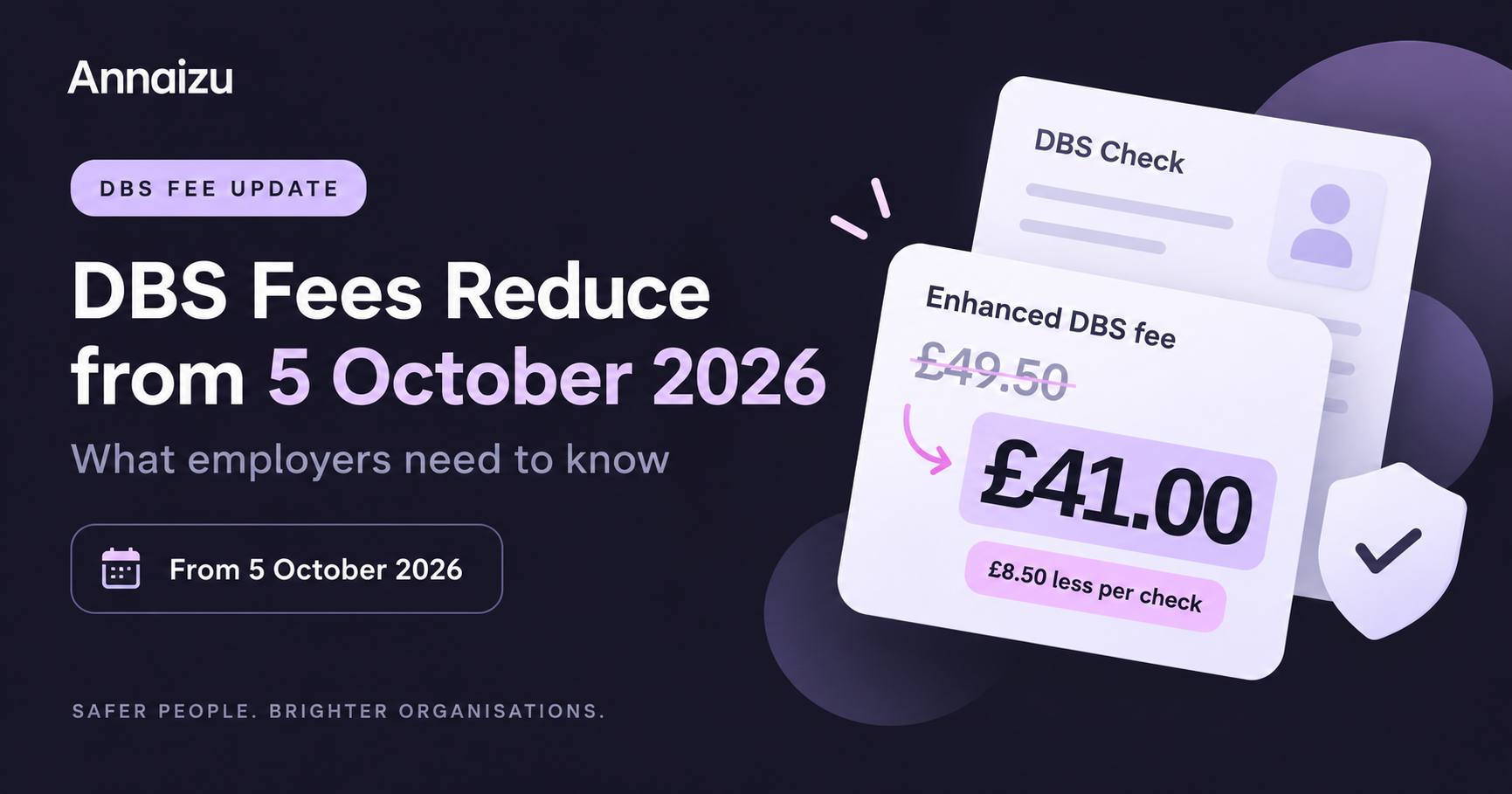
From 5 October 2026, the government DBS fee for a Basic or Standard check is £20, and the Enhanced DBS fee is £41. Qualifying Standard and Enhanced volunteer checks remain free of the DBS application fee, although provider administration charges may still apply. These are statutory DBS charges, not necessarily the complete provider price.
Choosing a workforce category does not determine the fee. The check level, eligibility and the service provider's charges matter. For the wider change, see Annaizu's guide to the October 2026 DBS fee reduction.
Manage DBS applications with Annaizu
Annaizu gives UK employers an online route to request and track eligible Basic, Standard, Enhanced and volunteer DBS applications. It helps recruitment teams follow application stages and outstanding actions rather than managing each check through disconnected email chains.
Our employer DBS pricing is volume based. Enhanced DBS from £46 per check in qualifying volume bands, with other check types listed on our live pricing page. Your actual price depends on the check, number of applications and applicable terms.
Annaizu supports the application workflow. The employer remains responsible for assessing the role's eligibility and recruitment decision, and DBS issues the certificate.
Prices include statutory DBS fees where applicable. VAT and eligibility conditions apply as stated on the pricing page. Check the relevant volume band before ordering.
Frequently asked questions about DBS workforce types
Is the workforce type the same as the DBS check level?
No. A workforce describes the relevant work category. A check level defines the criminal record information that can be requested. The legal eligibility rules determine whether the position qualifies for Standard, Enhanced or barred list information.
Do Basic DBS checks require a workforce type?
No equivalent workforce selection is needed for a Basic check. Basic DBS checks can be requested for a much broader range of purposes, but they only disclose the information available at Basic level.
Does Child Workforce always mean an Enhanced DBS check with a barred list?
No. An eligible child-facing role may qualify for Enhanced disclosure without barred list information. The employer must establish the basis for the specific barred list check, applying the updated rules in force since September 2026.
Can one DBS application cover both children and adults?
Yes, where the role genuinely meets the appropriate criteria in both workforces. The employer must still establish eligibility for each relevant barred list separately. Working with members of the public of different ages is not enough on its own.
Can a self-employed person apply for an Enhanced DBS check in 2026?
Some can. Since 21 January 2026, eligible self-employed people and personal employees have been able to apply for Enhanced and eligible barred list checks through a DBS Umbrella Body. This is not a blanket entitlement for every self-employed role. See the government's self-employed DBS guidance.
What happens if we choose the wrong workforce type?
Contact the organisation handling the application and correct the information as early as possible. A mistake may cause extra queries or affect whether the check was lawfully requested. If you think the level of disclosure is not permitted, review the official eligibility guidance before proceeding.
Where can I see Annaizu DBS prices?
Visit the Annaizu pricing page, find the DBS section and select your expected check volume. The displayed price includes the statutory DBS fee where applicable and identifies the relevant terms.

.svg)