

Discover the importance of Annaizu Compliance Management in today's business landscape and how a Home Office compliance management platform can help your business streamline its compliance efforts, reduce risks, and stay ahead of regulations.
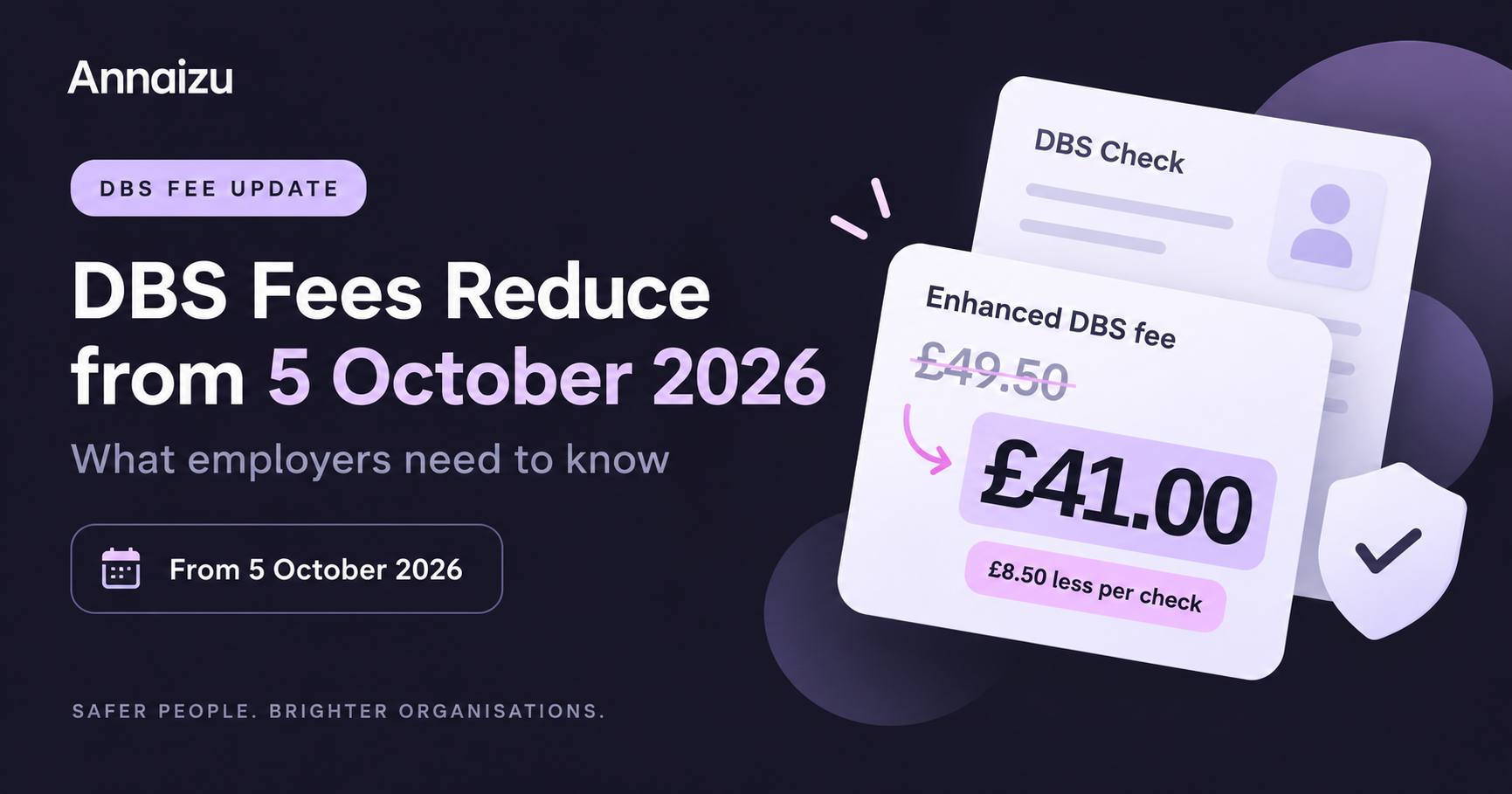
One recruitment cost is heading in the right direction. The Disclosure and Barring Service has announced lower fees from Monday 5 October 2026.
For employers, the useful question is not just how much a check will cost. It is what the change means for your next recruitment budget, your provider's invoice and the process your team follows before someone starts work.
This guide compares the figures, shows the savings at different application volumes and explains what to review before the change. You can also explore Annaizu's online DBS checks and check current Annaizu pricing alongside your requirements.
This guide covers roles in England and Wales; Scotland and Northern Ireland have separate disclosure routes.
A smaller checking bill. The same need to get recruitment right.
DBS fee only. Provider charges are separate.
The largest reduction is for Enhanced checks.
What are the new DBS fees?
Basic and Standard checks share the same fee, but they are not interchangeable. Use the table to update your budget, not to decide which level of disclosure a role needs.
| Product | Before 5 October |
From 5 October |
Saving | Reduction |
|---|---|---|---|---|
| Basic check | £21.50 | £20.00 | £1.50 | 7.0% |
| Standard check | £21.50 | £20.00 | £1.50 | 7.0% |
| Enhanced check | £49.50 | £41.00 | £8.50 | 17.2% |
|
Update Service Annual subscription |
£16.00 | £15.00 | £1.00 | 6.25% |
DBS fees, not provider quotations. Swipe the table on mobile.
DBS says the reduction follows its annual review of delivery costs and does not weaken its checking standards. Providers can still charge separate administration fees.
What could your organisation save?
The saving depends on the checks you actually need, not your total headcount. Start with expected applications during your budget period, split them by check type and apply the reduction to each category.
For example, an organisation arranging 100 paid Enhanced checks would see its DBS fee component fall from £4,950 to £4,100. That is a calculated reduction of £850, before considering any provider charges.
Illustrative comparison for 100 paid Enhanced checks.
Suppose your planned applications include 100 Basic, 50 Standard and 100 Enhanced checks, all for paid roles. The combined reduction in the DBS fee component would be:
Your comparable DBS fee budget would move from £8,175 to £7,100. Keep provider charges as a separate budget line so you can see whether your overall cost changes by the same amount.
For a useful comparison, ask each supplier to quote for the same mix and volume. A low advertised starting price is not enough to tell you what the whole recruitment programme will cost.
The DBS fee is not always the total you pay
When comparing quotations, ask for an itemised breakdown. Otherwise, a government fee and a provider's complete application price can look like competing offers when they describe different things.
The DBS fee
The published charge for the relevant check. This is the component compared in the fee table above.
The service price
Your provider's quotation may also cover administration or other services. Ask which charges and any applicable VAT are included.
For Annaizu, the pricing page explains that statutory DBS fees are included where applicable and that VAT applies to its service fee and VATable digital services. It also offers volume based pricing. Check the live price for your selected service and expected number of applications.
For applications close to the changeover, ask your provider which fee applies and when it is determined. Your internal approval date, payment date and submission date may differ. Get the answer before committing a budget or quoting a candidate.
Do not delay a necessary check just to reduce the bill
A saving should not determine whether someone starts before the required recruitment checks are complete. Plan around the role's requirements and your intended start date first, then confirm the applicable fee.
Choose the check for the role, not the discount
A Basic check shows unspent convictions and conditional cautions. A Standard check can disclose spent and unspent convictions and cautions, subject to filtering. An Enhanced check adds consideration of relevant information held by local police.
Standard and Enhanced checks require legal eligibility. A lower price does not make a higher level of disclosure available for every job. An Enhanced check with a check of one or both barred lists has further eligibility requirements; barred list access is not automatic.
Before requesting a check, write down the actual duties, the people the role involves and the level of disclosure you are entitled to request. A job title alone is a poor starting point for an internal checking decision.
Use Annaizu's DBS check options to explore the application routes, then confirm eligibility before applying. Keeping that decision separate from procurement helps avoid treating a more expensive check as an automatic upgrade.
The Update Service needs its own process
The annual subscription is separate from an application for a new check. The service covers Standard and Enhanced certificates, not Basic certificates. Applicants registering after their certificate is issued must join within 30 days of its issue date.
A subscription is not an automatic hiring clearance
Before a status check, follow DBS guidance on viewing the original paper certificate and verifying identity. Obtain consent and confirm entitlement to the same check level, workforce and any relevant barred list information. A photograph or video view of the certificate is not sufficient.
DBS does not automatically notify employers when a certificate's status changes. Its guidance recommends a checking schedule based on the role, risk and applicable requirements. An employer may pay for a subscription with permission, but the subscription remains personal to the individual.
Decide who will explain registration to new starters, who will carry out permitted status checks and who will act when a result needs further attention. That ownership matters more than simply recording that an employee has joined the service.
What about volunteer DBS checks?
Eligible Standard and Enhanced volunteer applications remain free of the DBS application fee. Basic checks are not covered by this exemption. Unpaid work does not automatically qualify: work placements, course requirements and certain trainee roles fall outside the volunteer criteria.
The Update Service is also free for qualifying volunteers. A provider's service charge is a separate question, so confirm eligibility and the total payable before describing an application as completely free.
Your preparation checklist
Treat the fee change as a focused review rather than a reason to rebuild your entire onboarding process. Give each action an owner and keep the updated information where recruiters and finance colleagues will actually use it.
-
Recalculate the applications you expect
Use realistic recruitment volumes, split by check type. Keep DBS fees, provider services and any subscriptions separate so the assumptions remain visible.
-
Get the provider's changeover position
Confirm the total payable and how applications around 5 October will be charged. Share the answer with anyone who raises orders or approves candidate expenses.
-
Review candidate communications
Check offer packs, onboarding emails, payment instructions and internal guides for old figures. Explain who pays and what the quoted amount includes.
-
Recheck the role requirements
Keep the eligibility decision alongside the request. Escalate uncertainty rather than ordering a higher level of disclosure because the price gap has narrowed.
-
Give follow up work a named owner
Decide who checks application progress, reviews results and manages any permitted Update Service status checks. Make the handover clear when a colleague is away.
A useful final test is to follow one application from the hiring manager's request to the recruitment decision. Can each person see what they need to do next, and can finance explain the charge without reopening several email threads?
How Annaizu supports the application process
Annaizu provides an online route for managing DBS applications and following their progress. Employers can explore Basic, Standard and Enhanced checks, confirm the appropriate route and guide applicants through the required steps. Processing times vary, so an estimate should not be treated as a guaranteed completion date.
When reviewing your setup, look at both the service and the price. Can applicants understand the instructions? Can your team identify outstanding steps? Does the quotation make sense for the volume of checks you expect?
Remember that a DBS check does not establish someone's Right to Work in the UK . Those are different checks with different purposes. Keep both visible in your recruitment process where relevant, rather than using one as evidence that the other has been completed.
Make your next DBS application easier to manage
Explore the check options with Annaizu, review current pricing and confirm what your organisation needs before applying.
Frequently asked questions
Does the fee reduction mean I need to replace existing certificates?
A DBS certificate has no official expiry date. Decide whether a new check is needed based on the role, your policy and any applicable requirements, not because a price has changed. A certificate reflects information available when the check was carried out.
Is an Enhanced check automatically the right option for every employee?
No. The duties must be eligible for that level of disclosure. Eligibility for barred list information must also be established separately. The lower fee does not create permission to request information you are not entitled to see.
Can a Basic certificate be added to the Update Service?
No. The Update Service is for Standard and Enhanced certificates. GOV.UK provides a separate online account route for Basic checks.
Can we rely on an employee saying their subscription is active?
That statement is not a substitute for the employer's permitted status check. Follow the DBS process for the original certificate, identity, consent and matching eligibility, then consider the result alongside your wider recruitment checks.
Where can I check Annaizu's total price?
Visit the Annaizu pricing page , select the relevant service and review the applicable volume band. Confirm the total payable and fee treatment for your application date before proceeding.
This article provides general employer information, not advice on an individual eligibility or recruitment decision. Check current official guidance and the provider's applicable terms before applying.



.svg)